Place
The fourth from the fire
Earth. Third from the Sun. Mars is the fourth, the last inner world before the asteroid belt and the gas giants. A neighbor with ground. Not a star. Not a story hung on a colour.
A World
Night, from Earth. Most of what stands in the sky is fire too far away to have a width: suns reduced to position. Against that field a few lights refuse to keep still. They share this Sun. A steady eye, and later a lens, can give them a disc. One of those discs is the colour of oxidised iron.
That light is Mars. Fourth from the Sun, last of the small rocky worlds before the belt of wreckage and the giants. The rust is ground: iron that met oxygen long ago and stained a hemisphere. Ice still holds both poles. The air is real, mostly carbon dioxide, and too thin to breathe. Two irregular moons ride with it. No person has stood there. Machines have. Everything that follows was learned across minutes of light, not years.
Before Olympus, before Ares, before anyone treated it as a destination: this is the object.
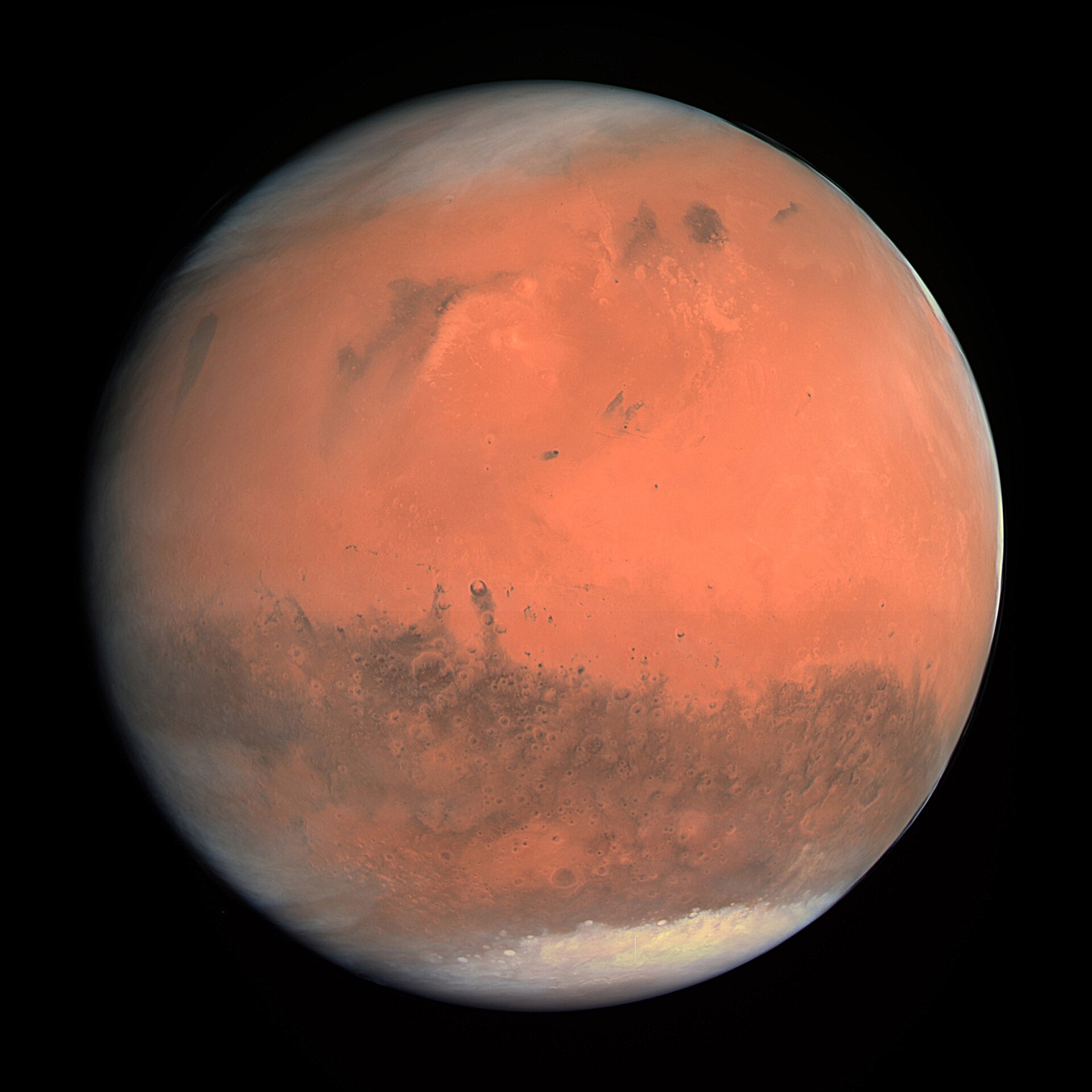
Sit with the neighbor before the mountain, the god, or the ship.
Scintillation is Earth’s air working on a point source. A nearby disc does not flicker the same way. You could still mistake it for a star. The glass, and later the machine, refuse that mistake.
Place
Earth. Third from the Sun. Mars is the fourth, the last inner world before the asteroid belt and the gas giants. A neighbor with ground. Not a star. Not a story hung on a colour.
Object
A rocky planet, about half Earth’s width, with about two-fifths the gravity. Colder. Drier now. A day a little longer than ours. A year of almost two of ours. Polar ice. Two small moons. An atmosphere that exists and will not keep you alive.
Colour
Iron in the crust met oxygen long ago and became dust. That dust is what a naked eye can have without a telescope. Chemistry, not a mood, and not a war-god leaking into the sky.
Distance
Not a fixed mileage. Both worlds move. Conjunction hides Mars behind the Sun. Opposition brings it close enough to dominate a night. The photons in your eye left minutes ago. There is no live conversation. There is no shout.
Age
It formed with Earth, about four and a half billion years ago. It once held thicker air and liquid water at the surface. The air thinned. The rivers stopped. The ice remained.
Knowing
Flyby, orbiter, lander, rover. Pictures, spectra, seismic listening, air sampled and split. Distance is not a preface to the planet. It is part of the planet.
Claim
The names are Earth’s: a Mesopotamian sign, a Greek wanderer, a Roman field-god, a Sanskrit blessing. The rock does not keep them. This house starts with the rock.
Walk
The light has mountains, a canyon that could take a continent, weather, seasons, a history of water. Then the names people hung on the colour. Then what it would take to stand there, and to stay.
First the ground, under different rules of gravity and crust. Then why the rivers stopped. Then the names. Then what it would take to stand there.
Ground · MEASURED
Before a named mountain, a split. Look at a height map: the south is high, old, and cratered; the north is kilometres lower and smoother, as if a hemisphere had been planed. Colour on the map below is elevation, not rust.
Earth’s crust slides in plates that carry mountains away. Mars does not, or has not for most of the time we can read. That is why a volcano can sit on one wound and keep building, and why a canyon can open and never close. From 2018 to 2022, InSight sat in the north and listened. Marsquakes. A metal core, at least partly liquid. The surface is a lid. Heat is still leaving.
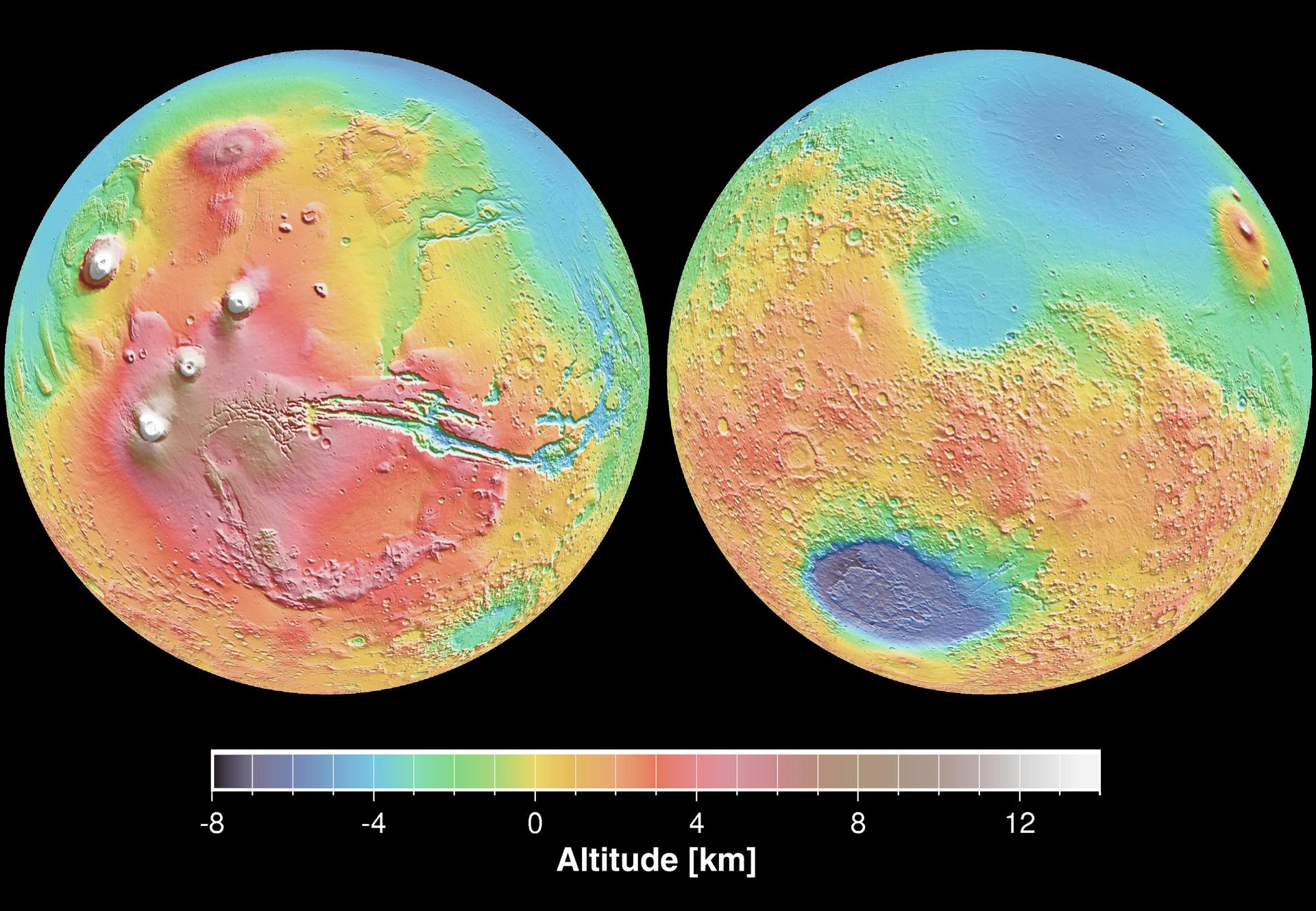
Colour is elevation, not the visible surface.
The first fact
Look at a height map and the planet splits. The southern highlands are thick-crusted, hammered with old craters. The northern lowlands sit kilometres lower, as if a hemisphere had been planed. That divide is the largest structure on Mars. How it formed is still argued: a giant impact, or heat and overturn from inside. The difference is not argued. It is measured.
The engine
Earth’s crust is a set of plates that move, collide, and carry mountains away. Mars does not work like that, or has not for most of the time we can read. A volcano can sit on the same wound and keep building. That is why Olympus is possible. Tharsis is a load that never left. Valles opened and never closed.
RECORDED · InSight
From 2018 to 2022 a lander named InSight sat in the north and listened. Marsquakes. A metal core, at least partly liquid. The planet is not Earth’s twin and it is not a museum piece. Heat is still leaving. The surface you will walk is the lid.
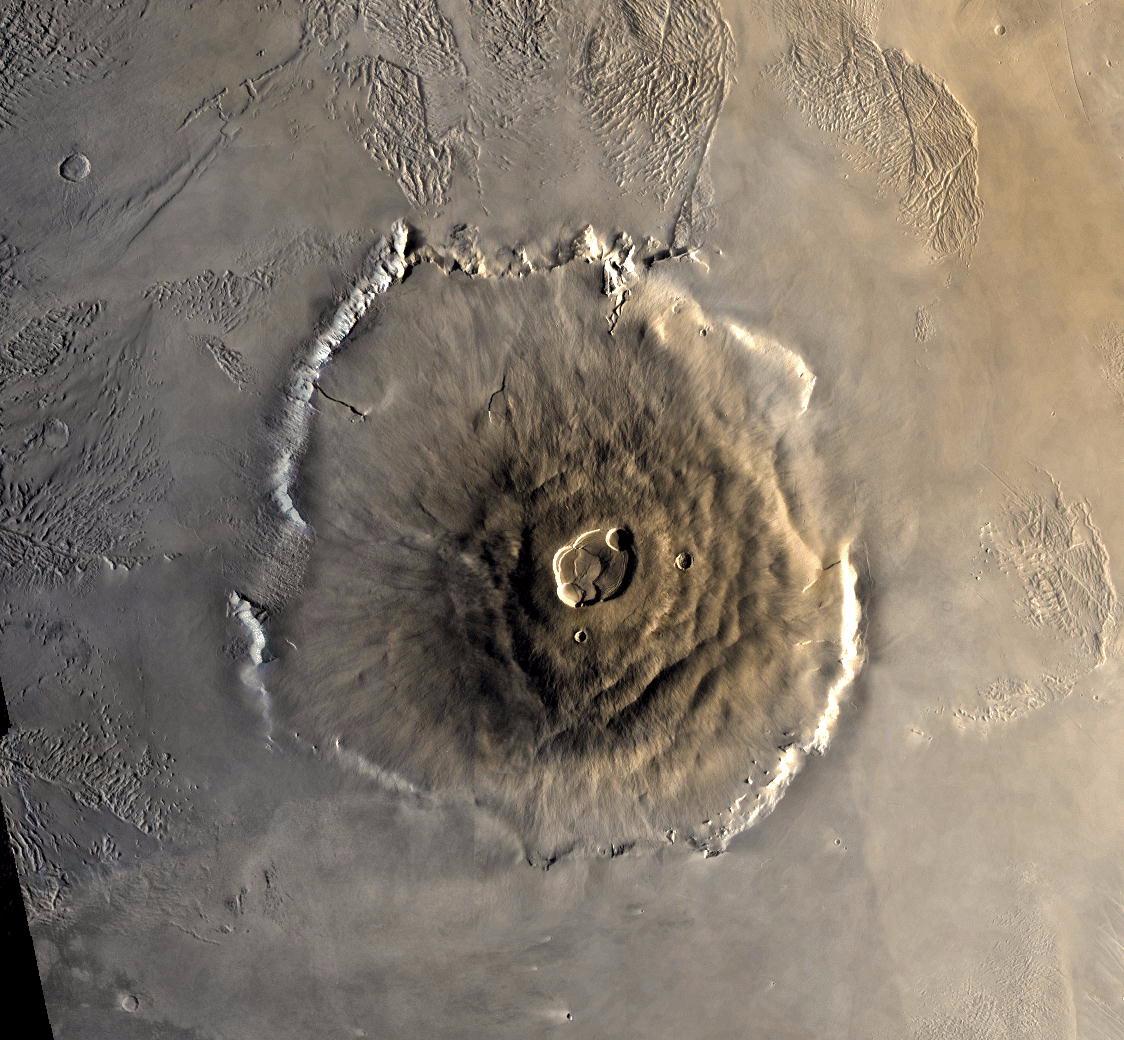
MEASURED
> 25 miles · > 40 km
A volcano so wide its base would cover Arizona. So tall that Earth’s highest mountain would sit on its slope like a foothill. Mars let it grow. Gravity here is weaker than Earth’s, and the crust does not slide in plates that carry a mountain away. The volcano kept building until the crust itself could not lift it higher. NASA’s public figure is more than twenty-five miles from base to summit. Other pages print 21.9 km. Height depends on which zero you stand on. Keep the uncertainty. The permission of geology is the point.
A mountain that makes Everest a foothill. Mars is not a small Earth. It is a different permission of geology.
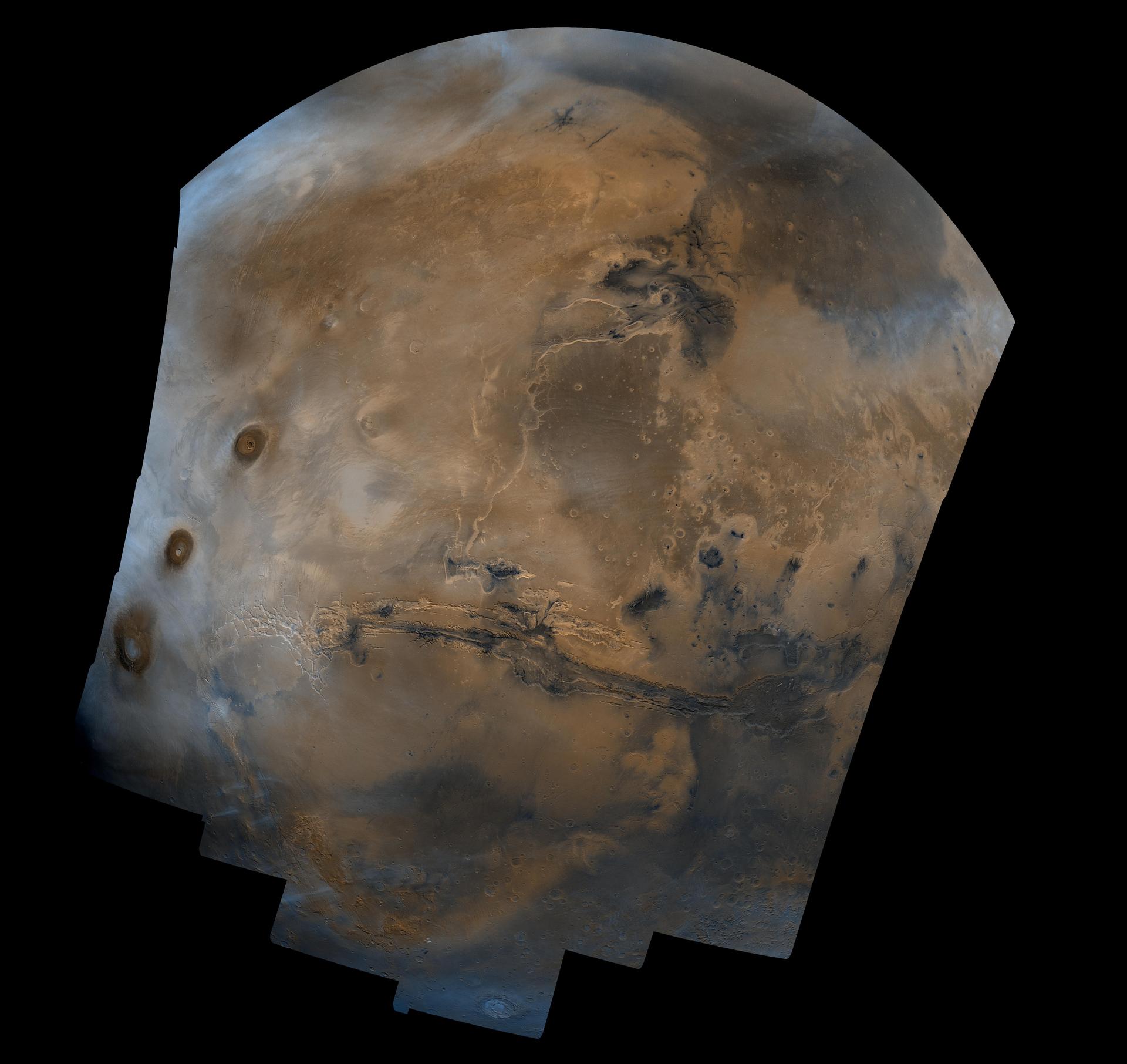
MEASURED
~ 3,870 km long · ~ 9.3 km deep
Long enough, NASA says, to stretch from California to New York. About 600 km across at its widest. More than ten times the Grand Canyon’s length and width. In 1971 a spacecraft named Mariner 9 flew around Mars and found this rift. The canyon is named for that ship. Not a river canyon in the terrestrial sense. A collapse, a wound in the Tharsis bulge that the planet never closed.
A canyon that is not a metaphor. Continent-scale failure of crust. You could lose a country in it and still have walls left.
Colour is elevation, not the visible surface.
MEASURED
~ 2,300 km across
An impact basin so deep that the air at its floor is the thickest on Mars. It sits as a hole in the old southern face. If you are looking for a place where parachutes have more to bite, this is one of the arguments. It is also a scar: a world that has been hit hard enough to remember it in topography.
Depth is weather. A hole this large changes the atmosphere that sits inside it.
MEASURED
A volcanic province the size of a continent
Three great shields in a line (Arsia, Pavonis, Ascraeus) and Olympus off the shoulder. Tharsis is not a mountain. It is a load. The mass of it is part of why Valles Marineris opened. Mars built a bulge and then cracked under it.
Volcanism here is not a postcard peak. It is the architecture of a hemisphere.
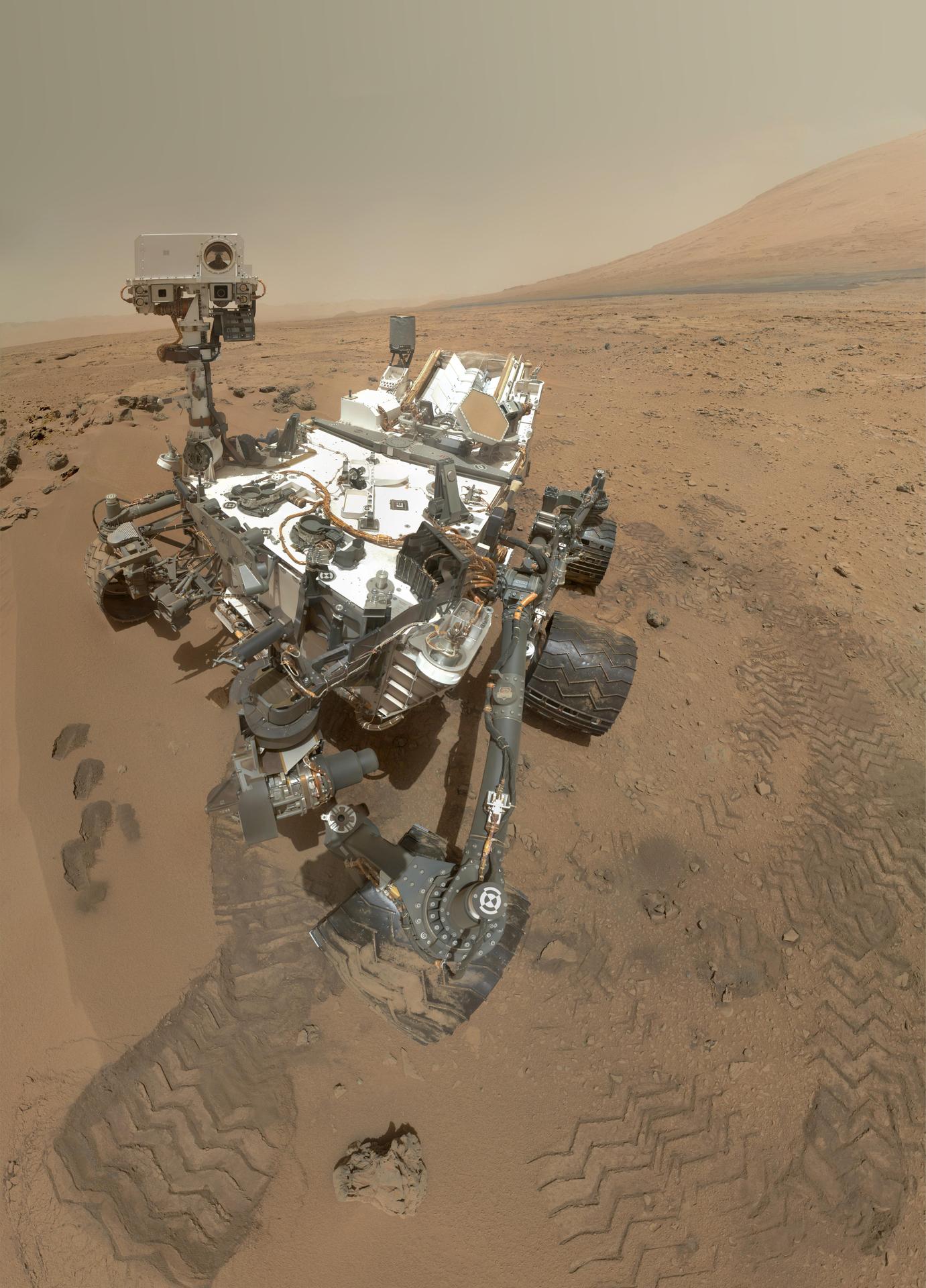
RECORDED
Curiosity’s home since 2012
In 2012 a rover named Curiosity landed in this impact bowl. A mountain in the middle, Aeolis Mons, is stacked like a library of climate. The rover did not go there to pose. It went to read stone that once sat in water and then did not.
A crater can be a book. Gale is why “Mars once had water” is a stratigraphic claim, not a slogan.
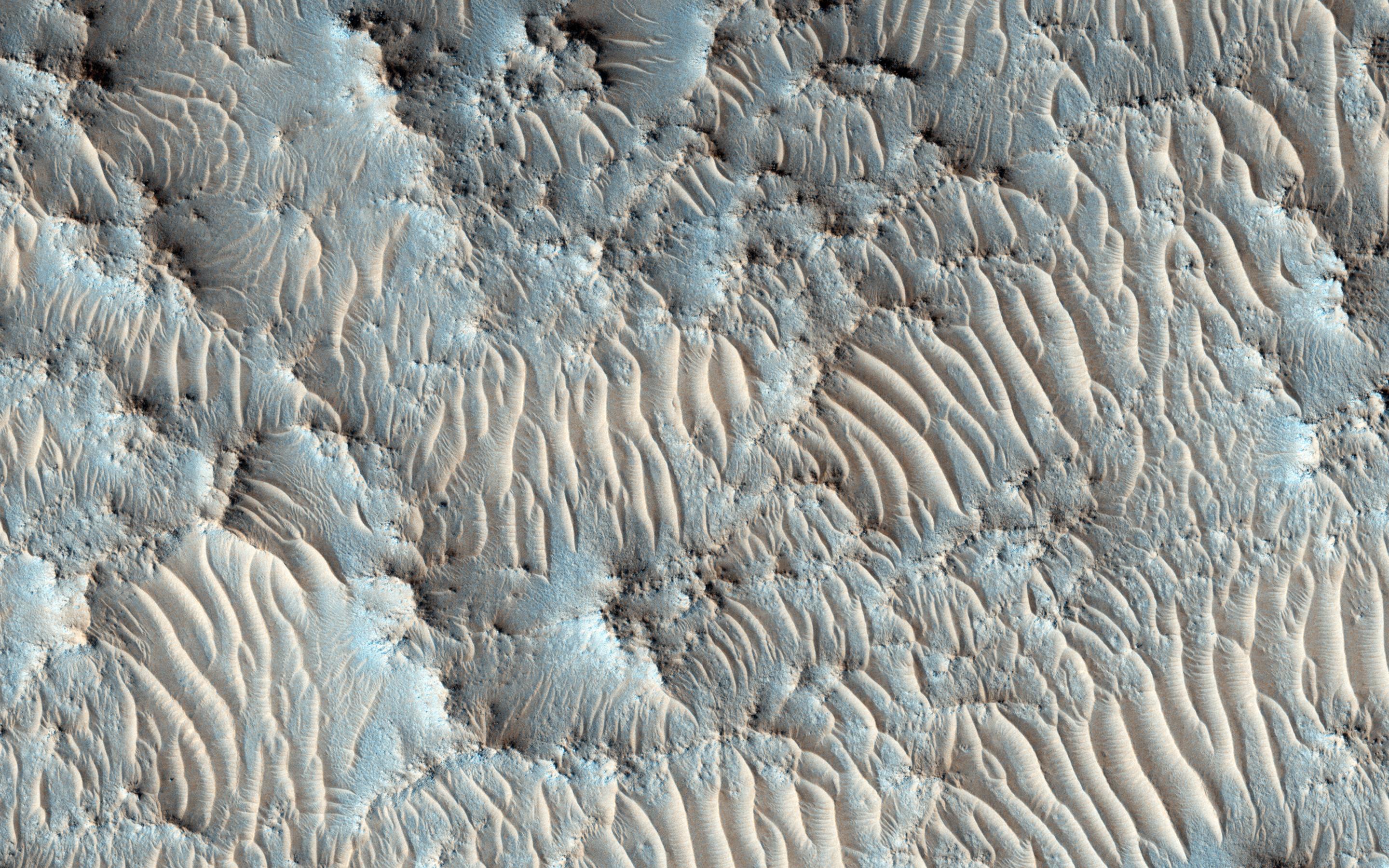
RECORDED
Perseverance, 2021–
A lake basin with a river delta still standing in rock. In 2021 a rover named Perseverance landed here. It is caching samples for a return that has not yet been built. The delta is the evidence. The cache is the bet that someone will come back.
A shoreline you can still see. Not because water is there now. Because rock is slower than weather.
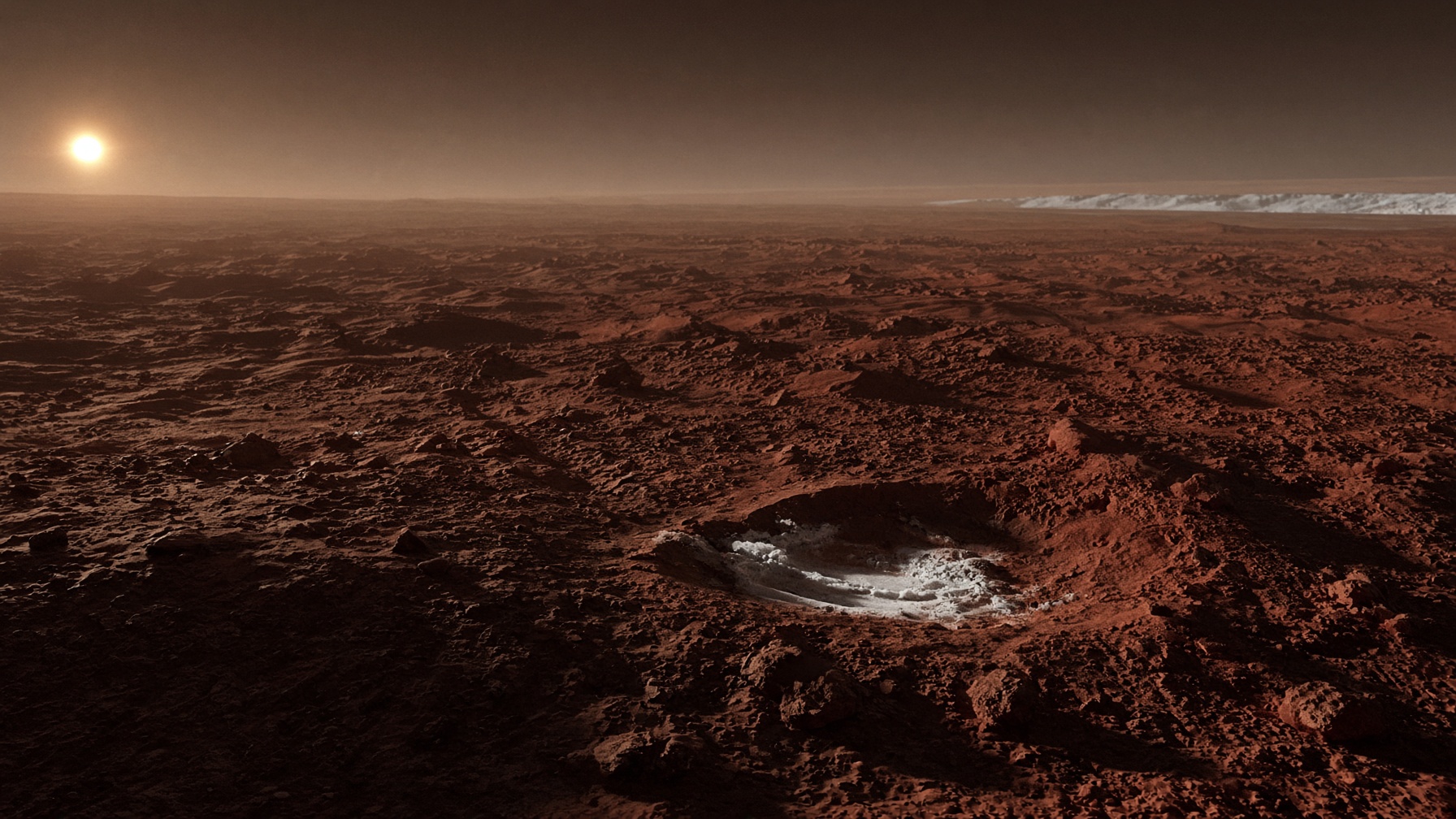
I had wind. Ice that does not melt the way yours does. A mountain that grew until this crust could not lift it higher.
Press Enter or click to complete the transmission.
Water · MEASURED
The highlands and basins you just walked are also a drainage. Branching valleys, closed lakes, fans of sediment, minerals that only form with liquid: the planet kept a wetter youth in stone. That is stratigraphy, not nostalgia.
Liquid at the surface needs air thick enough, and warm enough, for water to stay water. Mars lost that permission slowly. MAVEN, in orbit since 2014, measured the leak: oxygen, carbon, hydrogen, stripped by the solar wind, faster in storms. How warm, how wet, how continuous: still argued. The beds are not.
01
They branch. That is the signature of repeated flow across a catchment, rain-fed or melt that behaved like rain. Not one flood carved into dry ground.
02
Some craters have an inlet and no outlet. Water stood. Jezero held a lake. Gale held a lake. Hellas may have held a sea. The argument lives in shorelines and minerals.
03
Where a river meets still water, it drops what it carried. Jezero’s fan is still there: layered, waiting. Perseverance is walking it.
04
Opportunity, Meridiani Planum, 2004. Orbit had seen gray crystalline hematite. On the ground it was BB-sized spherules, nicknamed blueberries, weathered out of sandstone. The usual reading is water-rock chemistry, acidic, old. A mineral can change the picture when a picture cannot. It is not biology.
05
Curiosity climbs a mountain of climate. River gravel. Lake mud. Dune beds after the water failed. The stack is a clock.
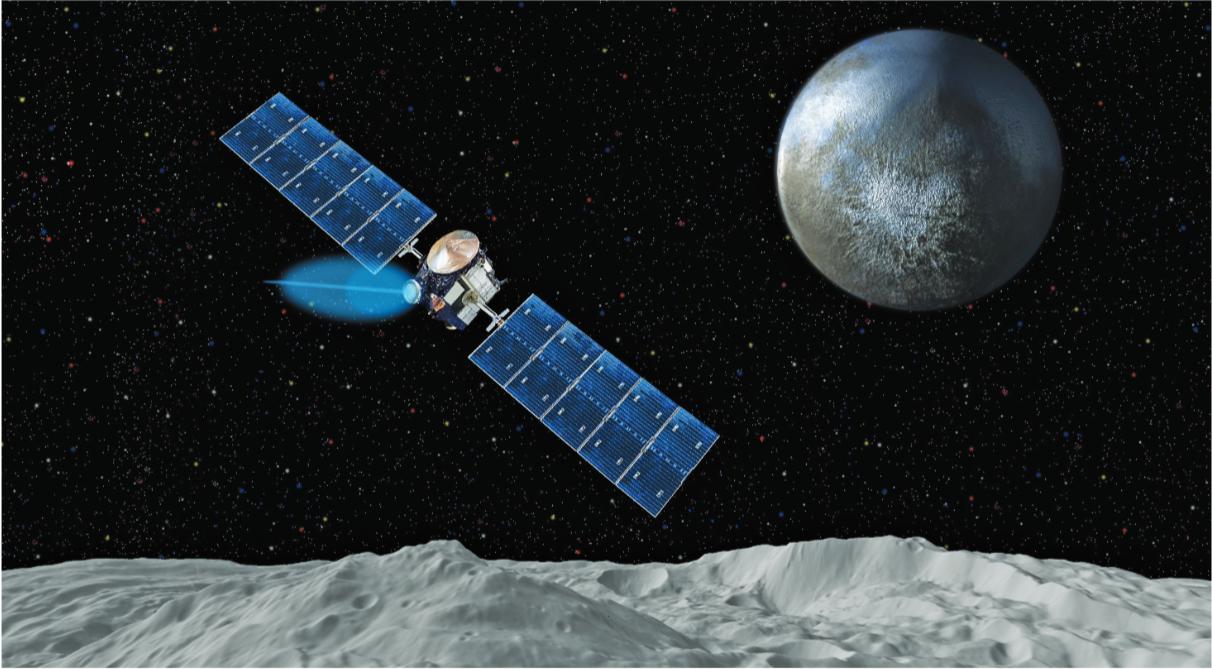
What happened to Mars?
The young planet could keep liquid at the surface. It has no global magnetic field like Earth’s, so the solar wind works on the upper air directly. MAVEN, in orbit since 2014, measured ions leaving. The loss is not a single catastrophe. As the air thinned, liquid water became less stable. What remained hid as ice, as hydrated minerals, as vapor that still leaves a molecule at a time.
How warm, how wet, how long, how continuous: those are still research questions. Episodic wet and a long wet era are not the same climate. Valleys, deltas, lakes, clays are there to be read. The continuity is not.
Today the air is about 6 millibars. Ice is abundant. Rivers are not.
Polar caps of water ice and carbon dioxide. Mid-latitude glaciers under dust. Subsurface ice the size of lakes, found by radar. The water did not all leave. Much of it froze, or was buried, or went with the air.
Weather · MEASURED
Mars has an atmosphere, a tilt of about 25.2°, and a year of 687 Earth days. That is enough for seasons, polar frost, and dust that can wrap the globe. It is not enough to stand in. Surface pressure is about 6 millibars, mostly carbon dioxide: less than one percent of Earth’s at sea level.
A sol is 24.6 hours. Almost a terrestrial day, which is the trap. Thermal design does not live on almost. Gravity is about 0.38 g. The equator can be tolerable in noon sun and lethal after dark in the same sol. Dust is a planetary process: it scatters a blue sunset, dims solar arrays, and in 2018 ended Opportunity while the Sun was still there.
~ 24.6 hours
NASA: Mars rotates once every 24.6 hours. A solar day is a sol. Crews would live on sol clocks. The length is almost familiar. Almost is not enough for pumps, batteries, or sleep.
687 Earth days · 669.6 sols
A long year. Seasons last longer, and they are not equal. Polar CO₂ frost grows and retreats. Dust storm season has a calendar.
25.2°
Close to Earth’s 23.4°. Seasons exist for the same geometric reason. The orbit is more stretched, so the two hemispheres do not get the same spring. Obliquity also wanders over long timescales, which is part of why ice has moved.
0.0934
About six times Earth’s 0.0167. Only Mercury among the planets is more stretched. Perihelion 1.381 AU. Aphelion 1.666 AU. Insolation at perihelion is about 45 percent higher. That is why southern summer is short, harsh, and dusty. The stretch itself wanders over tens of millennia.
~ 6 mbar · ~ 96% CO₂
Too thin to breathe, too thin to stop most meteoroids, too thin for easy parachutes, thick enough for dust storms and entry heating. The awkward atmosphere is an engineering character, not a footnote.
~ 0.38 g
You weigh less. Dust hangs differently. Landing bleeds speed more slowly. Bones and fluids would have their own long argument with that number.
Often well below −60 °C
Noon and night on the same equator can be different worlds. Thermal control is not comfort. It is whether lubricants stiffen and pumps freeze.
Two springs · MEASURED
Mars leans about 25.2°, close to Earth. Four seasons, a long year. Northern spring runs about 194 sols. Southern spring, which is northern autumn, only 142. The orbit is stretched, so southern summer is nearer the Sun: shorter, harsher, dust. There is ground. There is ice. Spring is not a metaphor.
RECORDED · 12 Sep 2001
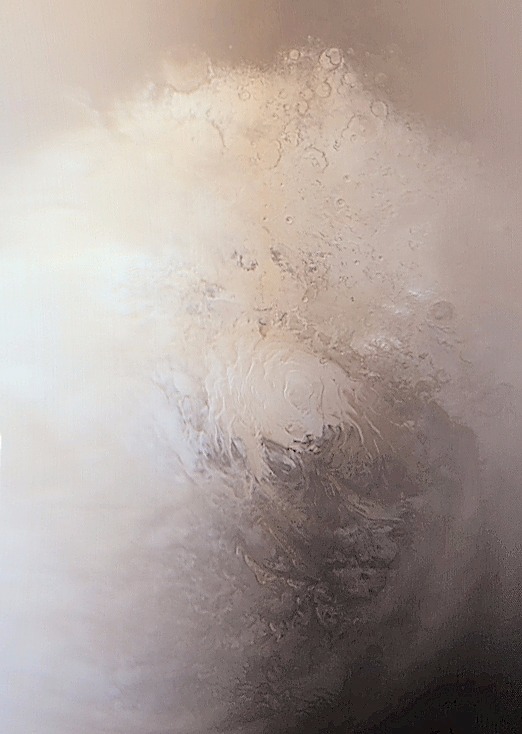
Southern spring. Seasonal frost leaving. Permanent cap remaining, about 420 km across.
Mars Global Surveyor, four years to the day after it first began to orbit. Southern winter had ended on 17 June. The bright centre is the permanent cap, the ice that will last the summer. Around it, seasonal frost of water ice and carbon dioxide, laid down in winter, is leaving as vapour. Afternoon clouds sit over the cap. Spring here is frost going back into the air. The lyric asked what spring is like. This is a photograph of the short one.
NASA · the remaining cap
420
km across
NASA prints the remaining cap at about 420 kilometres across. Scale on the plate. Not a climate proof, and not why the ice stays.
The two springs
Tilt makes seasons. Eccentricity 0.0934 makes them unequal. Perihelion 1.381 AU. Aphelion 1.666 AU. The slider is time, one Martian year of 669 sols. Northern spring occupies more of the bar than southern spring. That is Kepler: equal areas in equal times. 142 is how long the fast spring lasts, not a setting.
194
Northern spring · sols
142
Southern spring · sols
Kepler, not poetry. Eccentricity 0.0934. Perihelion 1.381 AU, aphelion 1.666 AU. Farther from the Sun, slower. Northern spring rides the slow arc near aphelion. Southern spring rides the fast one, with about 45 percent more sunlight. NASA prints 194 and 142. The LMD areocentric table is 193.3 and 142.7. The path is not a circle. That is why a season can be counted, and why a window can later be missed.
NSSDC · the stretch
42.6
million km
Perihelion 206.6 million km. Aphelion 249.2 million km. The gap is about 42.6 million kilometres. Honest arithmetic on a fact sheet. A distance, not a climate proof, and not why the ice stays.
BOOK · a song
Let me see what spring is like on
Jupiter and Mars.
Bart Howard, 1954. A standard, not a science paper. The wish is allowed. This house answers one of the two names. The song came before the sol count.
LIVED · a rhyme
142
1954. Bart Howard writes the lyric. Originally In Other Words. The two names are already in the song. FLY ME TO THE MOON, full reduction, is 69. JUPITER AND MARS, English ordinal, is 169. 24 July 2023. A kitchen. Joy before the name. The sum was not the event. Then this house measured the two springs. Southern spring, NASA’s teaching number, about 142 sols. CIPHER later: ELON REEVE, reverse ordinal, 142. FORTY TWO, English ordinal, 142. The methods are not mixed to force a hit. 69 is the song. 169 is the couplet. 142 is the short spring and a name. They do not prove one another. Meaning first. Number afterward. The correspondence may be kept. The cause remains open. Mars did not send a message.
MARS · can answer
Jupiter · another kind of spring.
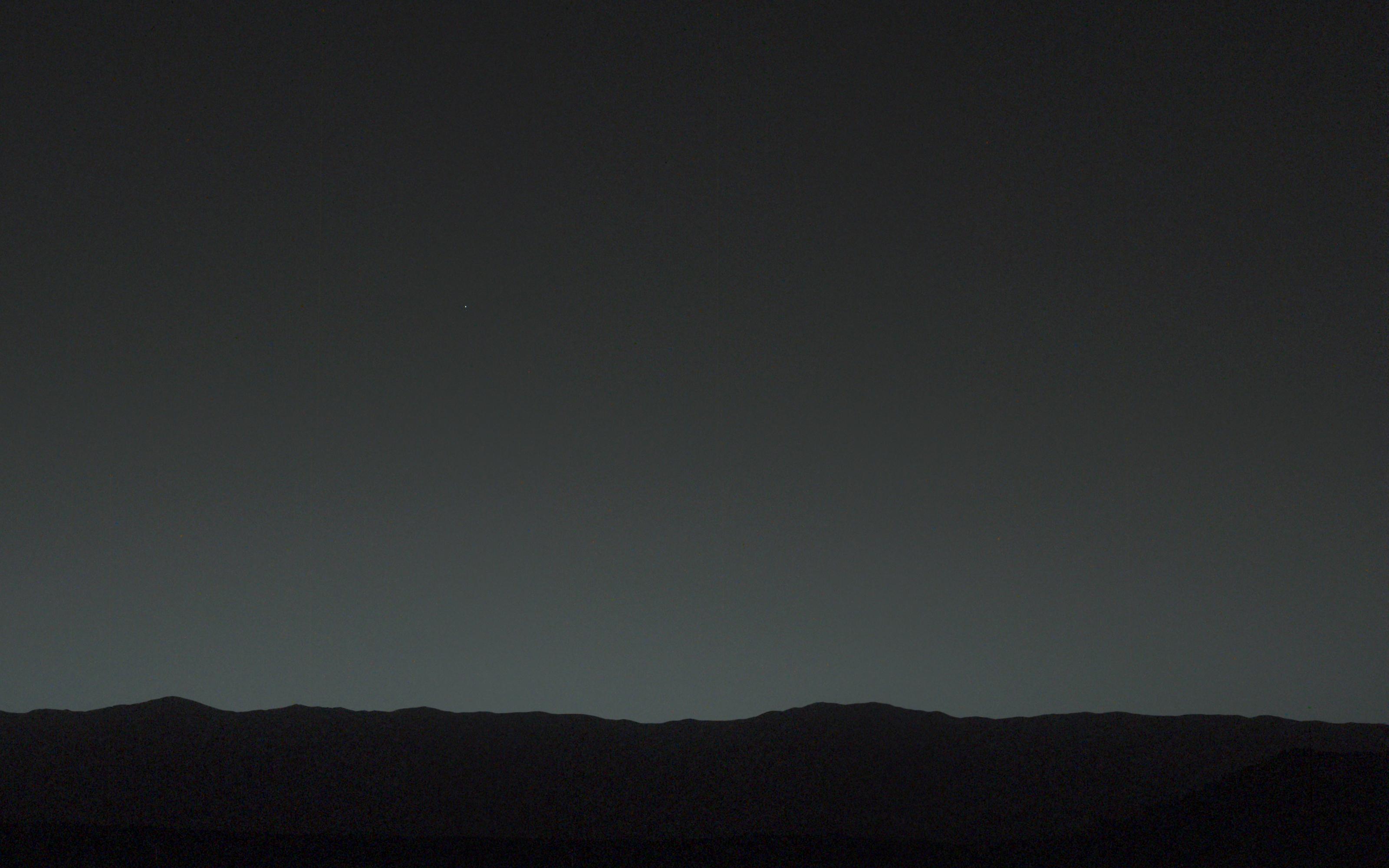
Curiosity has watched the Sun go down. The disc is small. Near it the sky can go blue because fine dust scatters the remaining light differently than Earth’s nitrogen does. A blue sunset on a rust world is particle size first.
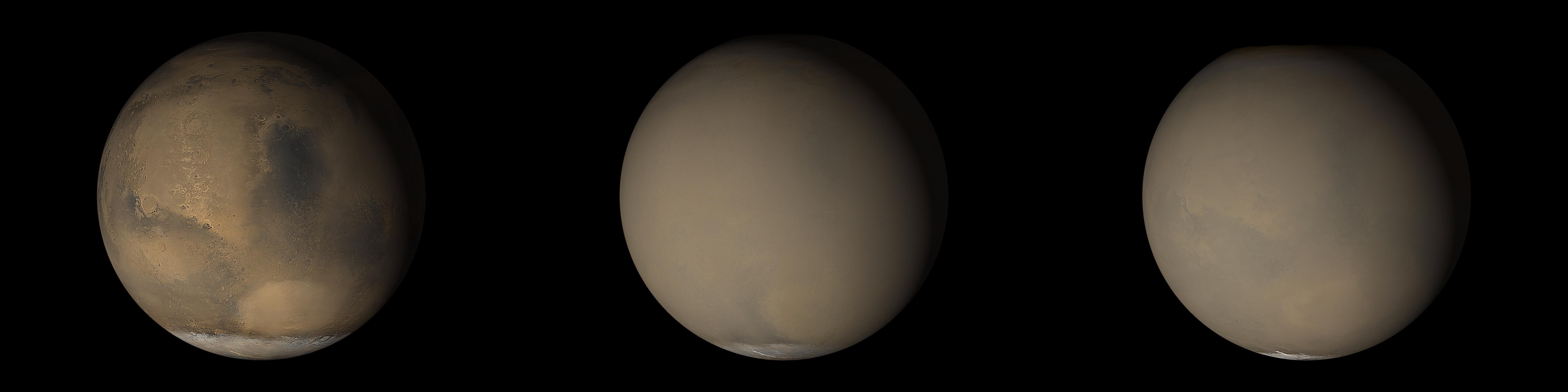
Dust is not inconvenience. Storms can be local, regional, or global. They dim solar arrays, charge hardware, scour seals, and change the temperature structure of the whole air. In 2018 a global storm ended Opportunity. The Sun was still there. The sky was not.
Moons · MEASURED
The thin sky you just met is the same sky two small moons cut through. They are not Earth’s Moon at any scale: tens of kilometres, irregular, dark. Not round. Not ice-bright. A captured asteroid, or debris from a larger strike: the origin is still argued.
Asaph Hall found them in August 1877 at the U.S. Naval Observatory in Washington, in the same close opposition that let Schiaparelli map the disc. Henry Madan, science master at Eton, suggested names from Iliad 15.119–120: Phobos and Deimos, attendants of Ares. Hall chose those. The rocks did not arrive with a family. A 19th-century classical habit supplied one.
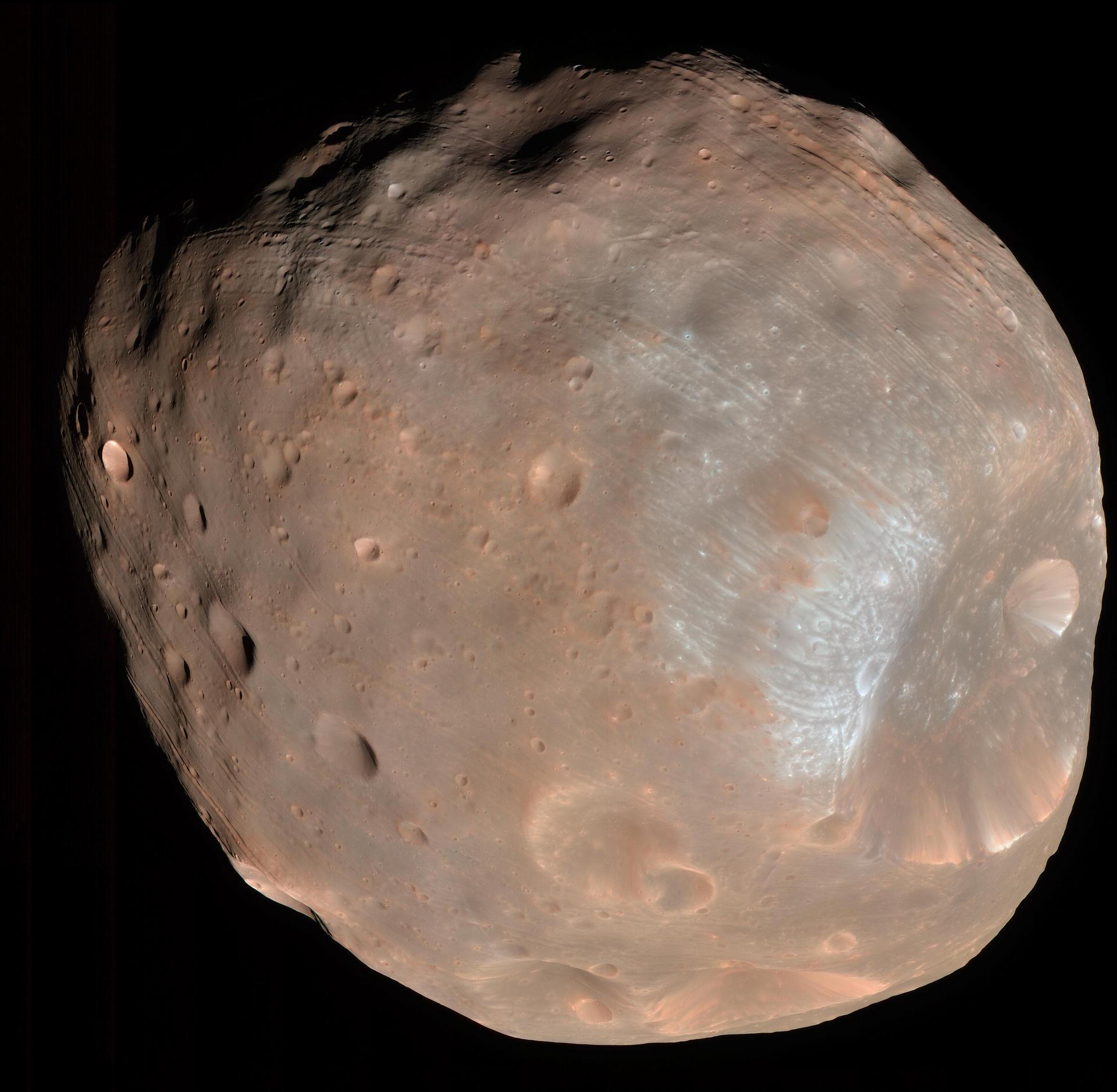
Φόβος · Fear
A moon so close it would look like a moving mountain if you stood under it. Not round. Not ice-bright. A captured stone or a leftover of a larger violence. The origin is still argued.
About 22 km across its long axis.
Rises in the west, sets in the east.
Stickney crater occupies a shocking fraction of the body.
Orbits in less than eight hours, inside synchronous radius.
Spiraling inward. On geological time it will break or strike.
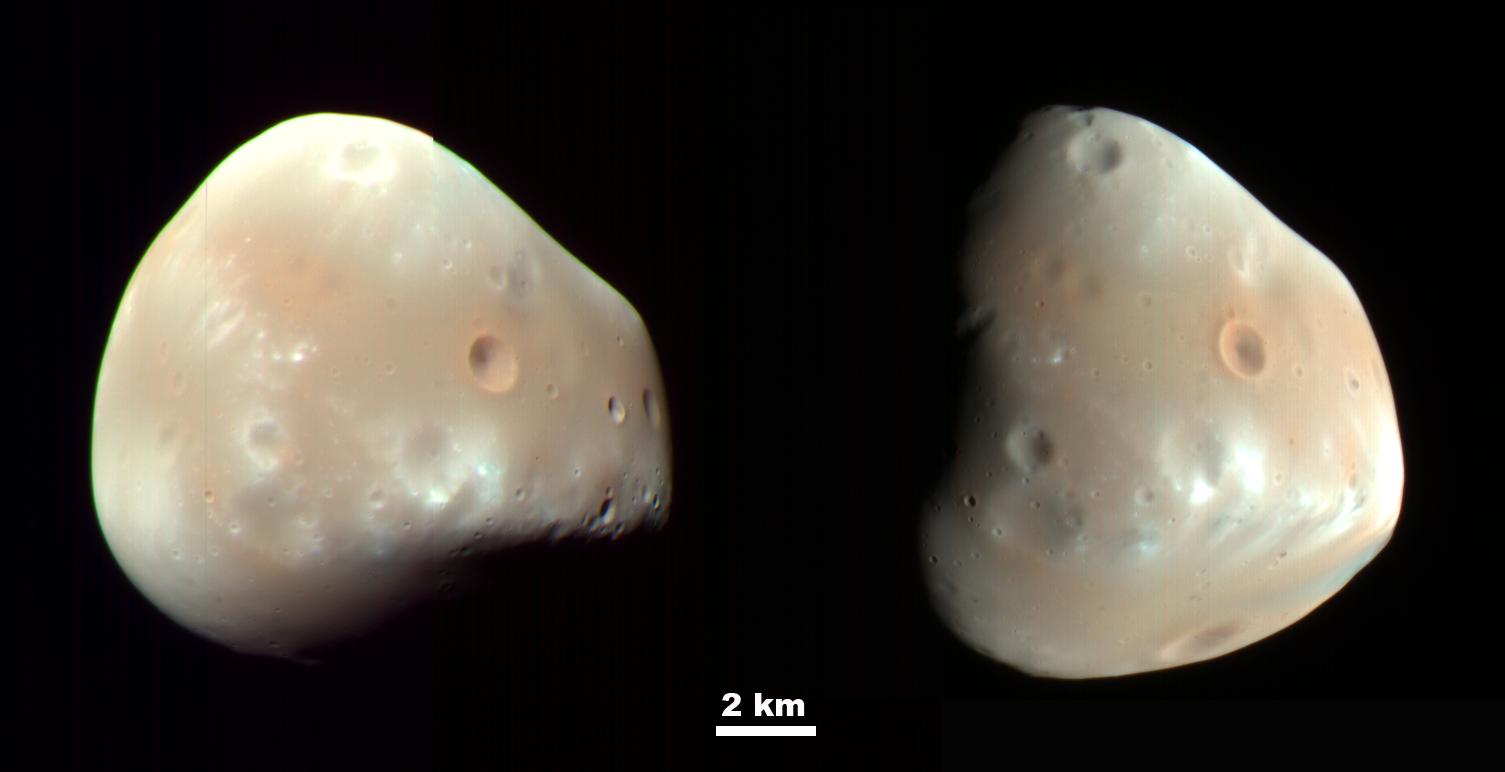
Δεῖμος · Terror
The quieter companion. Physics does not honor the genealogy. They are mass, orbit, and dust.
About 12 km across.
Also irregular, also dark.
Farther out, slower, dimmer.
A star that does not twinkle, if you did not know to look.
Two small irregular stones. Their names are not physics.
His notice is MNRAS 38 (1878) 205. The names came from a poem. The rocks did not arrive with a family. The light was a problem before it was a god.
Wanderer · MEASURED
Before a god, a problem the eye can have without a temple: a light that changes brightness, disappears into the Sun, returns, and sometimes loops against the fixed stars. Greek named that class πλάνητες, wanderers. English planet is that word.
What any one culture made of this particular wanderer is an office: omen, civic god, battle-rage, blessing, fiery star-name. The motion is not an office. Research the appearance and the name separately before relating them.
GREEK · the word
πλάνητες
ἀστέρες πλάνητες · wandering stars
Greek named the problem, not a god. Fixed stars keep their places. A few lights do not. Those lights are πλάνητες, from πλανᾶσθαι, to wander. Late Latin wrote planeta. English planet is that word. Latin could also say stellae errantes, wandering stars. The name is a description of motion against the field. It is not rust. It is not Ares.
This particular wanderer could also be called Πυρόεις, the fiery one, from the colour the eye actually had. That is a star-name. Ares is a poem-name. Keep them apart.
The sky gives a problem. Culture gives an office.
The problem
Colour that is not star-white. Brightness that swells and fades with the years. A season when it faces us all night. A season when the Sun swallows it. A loop against the fixed stars around the time it is brightest. Return, but not on a human wish. Another red lamp sits among the fixed stars: Antares, named as if it were a rival. The eye can confuse them. One wanders. One does not.
The office
Omen, civic god, plague lord, calendar mark, a name for a wanderer. Those are human answers. They are not properties of rust. Research the observation and the office separately before relating them.
Naked-eye
OBSERVED
The first office we can still read for this light is Mesopotamian. Scribes named it Ṣalbatānu. They watched colour, glare, absence, return. They could not see iron oxide, a shield volcano, or two stones. What they could do is write the appearance down, copy it, and send it.
INTERPRETED
Enūma Anu Enlil is not a personality chart. It is a long omen series: if a celestial thing appears thus, then king, harvest, war, or public order may stand in a certain way. Old Babylonian prototypes. A canonical form in the later second millennium. Neo-Assyrian scholars still cited it in reports to the king. The sky had become an archive of signs a state could use.
They could count return and colour. In Mesopotamia that count became a written omen for a king. Other names wait. They are offices, not the rock.
Names · TOLD
The first written job we still have for this light is not a Greek poem. It is a Mesopotamian sign, sent toward a king. Hall’s moons are a later Greek gift. Keep the centuries apart.
The myths disagree. Keep the disagreement. A red wanderer is not automatically a war god in every language that had a sky.
RECORDED
Babylonian and Assyrian scribal
First-millennium omen and sky lists. Older prototypes behind them.
Enūma Anu Enlil. MUL.APIN, Hunger and Pingree 1989. Astronomical diaries, Sachs and Hunger.
Scribes wrote the red wanderer as Ṣalbatānu. The etymology of that name is still argued, so this house does not pretend to settle it. They could also call it a red star, kakkabu makrû. Colour, brightness, disappearance into the Sun, return, a backward loop: that is what a naked-eye archive can hold. Enūma Anu Enlil, a long omen series, reads such appearances as signs for king and land: if this, then that. Astronomical diaries, from the later first millennium, can record the same planet as position and weather without that omen sentence. Observation and interpretation are different jobs. Both survive on clay.
TOLD
Mesopotamian
Kutha from the Early Dynastic world. Planetary identification in the astral tradition of the first millennium.
Temple E-Meslam. Nergal and Ereshkigal. MUL.APIN. Neo-Assyrian scholarly reports, Hunger SAA 8.
Nergal’s house is Kutha in northern Babylonia. Temple E-Meslam. He is a city god of inflicted death: plague, war, the underworld he comes to share with Ereshkigal. Erra is a related scorching figure, later syncretized. That cult does not require a planet. Ṣalbatānu is associated with him in first-millennium omen scholarship, including reports written to the Assyrian king. Other gods could be mapped onto the same light, among them the Elamite Simut. The identification is a scholarly office, not the origin of Kutha. This is not Ares in another hat. Do not write that they invented Nergal because the disc was rust.
TOLD
Greek
Archaic poems, as we have them from the 8th–7th c. BCE
Homer, Iliad 5.890–891. Perseus.
In the Iliad, Ares is battle-rage, the field where bodies are risked. At 5.890–891 Zeus calls him most hateful of the gods who hold Olympos. Athena is the craft of war. Ares is the cost. Listeners in the Greek-speaking world could see a naked-eye red wanderer. They could also call that light Πυρόεις, the fiery one, from the colour. That is a star-name. Ares is a poem-name. They are not the same office. Listeners could not see rust dust or a shield volcano. Reducing him to “war” as a brand is modern, and thinner than the poems. Hall later borrowed Fear and Terror from this world for two stones. That gift is not Mesopotamia, and it is not the rock.
TOLD
Roman
Older in Rome than the later Greek pairing
Livy 1.4. Cato, De Agri Cultura 141.
Roman Mars is not a copy of Ares with a Latin name. He is Mars Pater: agricultural, protective, a father of the city in Livy’s Romulus story (1.4), a god of the field in both senses, crops and campaign. Cato’s farm liturgy (Agr. 141) still addresses him there. March (Martius) opens the year of turning soil and of opening war. Civic identity, not only bloodlust. When Latin astronomy gave this name to the planet, it inherited a civic god, not a cartoon of violence. The later habit of reading him as “the Roman Ares” is interpretatio, not origin.
TOLD
Sanskrit / Jyotisha
The word is older than later natal handbooks. Planetary lists in the siddhantas.
Monier-Williams, मङ्गल. Also Kuja, the youth, and Aṅgāraka, the ember.
Mangala is not a translation of Ares. The Sanskrit is auspicious, a blessing, a Tuesday. The same light can be Kuja, the boy, or Aṅgāraka, the burning coal. Heat and a good mark occupy one name. That is why a later office can hear a builder in Capricorn and not only a raid. It is not the Iliad. It is not Ṣalbatānu. It is not a landing trajectory.
A written omen for a king. A city god of inflicted death. Battle-rage in a Greek poem. A fiery star-name beside that poem. A Roman father of fields and of the city. A Sanskrit blessing that is also an ember. A later astronomical label, planet, that only means the light would not stay put. If you need a single meaning, you are no longer doing history. The planet can carry all of these without collapsing them. None of them is geology. None of them is a reason the ice is still there.
SURVIVED
English still says martial for things that belong to war: the civic god, thinned to an adjective. March still opens a year named for him. Tuesday, in more than one language, is still this light’s day; Mangala remains a Tuesday. Holst scored a Bringer of War. Wells trained the public what Martian means. Natal astrology still files heat and a spear. Later psychology inherited a temperament word, not a world. Those are survivals. They are not the rust.
STILL
A rust disc. A cartoon of war hung on the colour. Canals that are not there. An alien. A destination. The image is older than the city and newer than Kutha. This house starts with the lamp so the cartoon does not get to go first.
Projection · RECORDED
Once a wanderer has been a sign for a king, the disc is ready to become a character. Telescopes do not end that habit. They give it new tools. Polar caps become seasons. Linear markings become canals. Canals become a dying civilization. A dying civilization becomes an invasion, a utopia, a backup of the species.
Mariner 4, in July 1965, returned a cratered strip. The canals failed in public. A new projection began immediately: dead world, not worth it. Which was also not the planet. The strip was taken for the globe.
How much of a world do human beings complete when resolution leaves a gap?
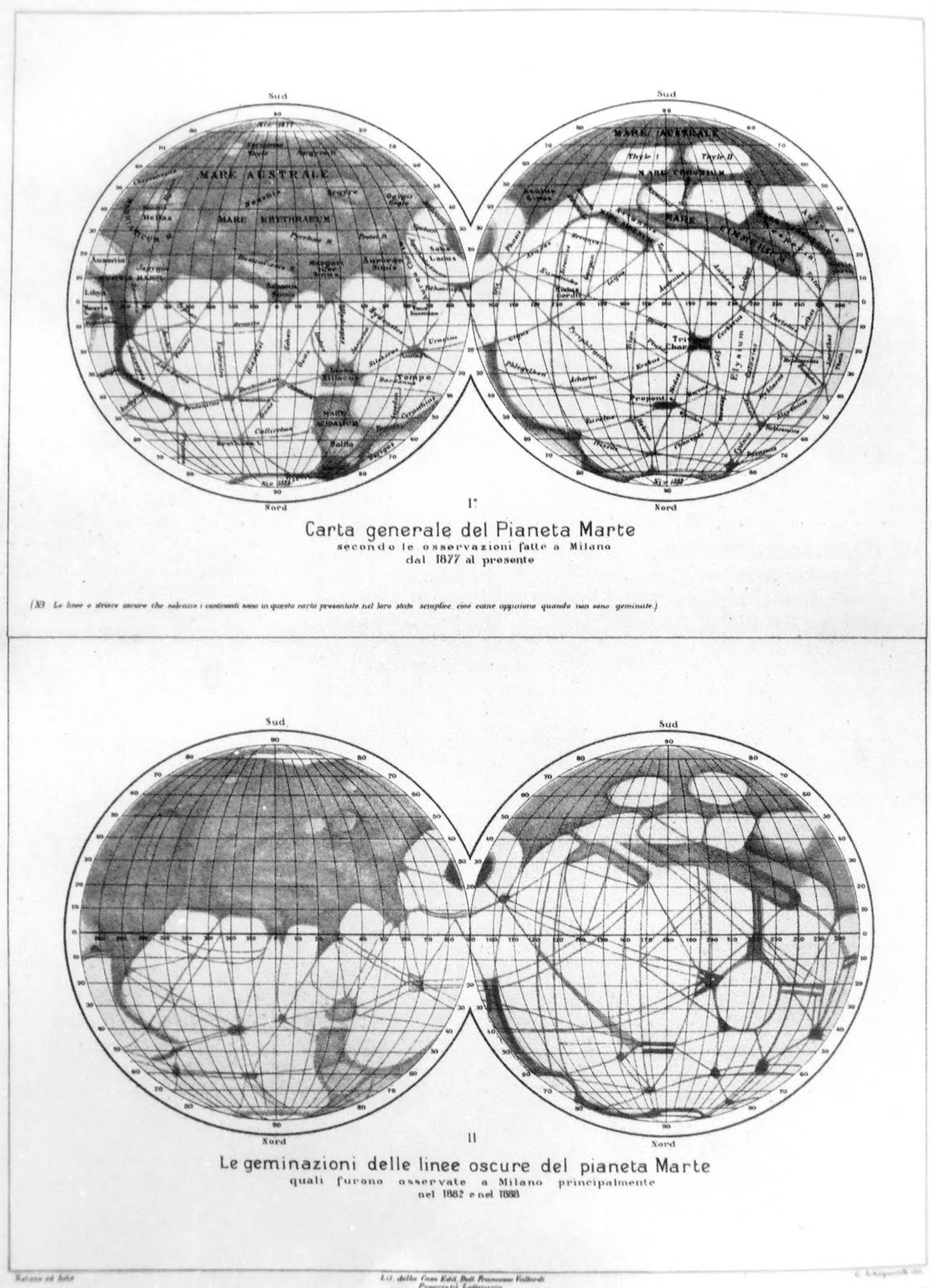
Historical source object. A drawing of canali, not a photograph of canals.
RECORDED · 1877–78
Giovanni Virginio Schiaparelli, Osservazioni astronomiche e fisiche sulla topografia e costituzione del pianeta Marte, Brera, opposition of 1877.
He named the linear features canali. In Italian canale is a channel or a canal. The word does both jobs. English print preferred canals. The engineering reading hardens in the second language. Angelo Secchi had already used canale in 1858 for a large dark marking, not a net. Schiaparelli drew a net, and gave it classical names. He did not, in that memoir, deliver a city of engineers. Later readers completed one.
1659–1780s
The Hague, 1659: Huygens sketches a dark marking we now call Syrtis Major. Cassini and others see white caps. Herschel, in the 1780s, reads seasons from those caps. Already a projection of Earth weather. Also a real measurement: the axis is tilted.
1877–78
Milan, Brera. The same close opposition in which Hall found the moons. A map, a memoir, a word that English heard as engineering.
1894–1916
Percival Lowell builds an observatory at Flagstaff to prove the canals. Dying planet, equatorial irrigation, intelligent engineers. Mars and its Canals (1906) is the book of that thesis. The maps are vivid. The canals, as canals, are not there. What was there: a will to read meaning into the limit of seeing.
1897–1938
England, 1897: H. G. Wells’s War of the Worlds turns the dying-planet story around. They come here. New York, 30 October 1938: Orson Welles, CBS. Mars as aggressor is a literary Mars. It still trains the public what Martian means.
14–15 July 1965
Mariner 4. Twenty-one complete frames, part of a twenty-second, about one percent of the planet. No canals. Contemporaneous reading: a Moon-like desert, perhaps never an ocean. The dying-civilization maps fail in public. A new error begins at once: dead world. The strip was taken for the globe.
1971–1976
Mariner 9 arrives into a global dust storm, then sees volcanoes and Valles Marineris as the air clears. Viking 1 lands in Chryse Planitia on 20 July 1976. Mars becomes geology you can stand a machine on. The world is particular now: not blank, not city, not simple.
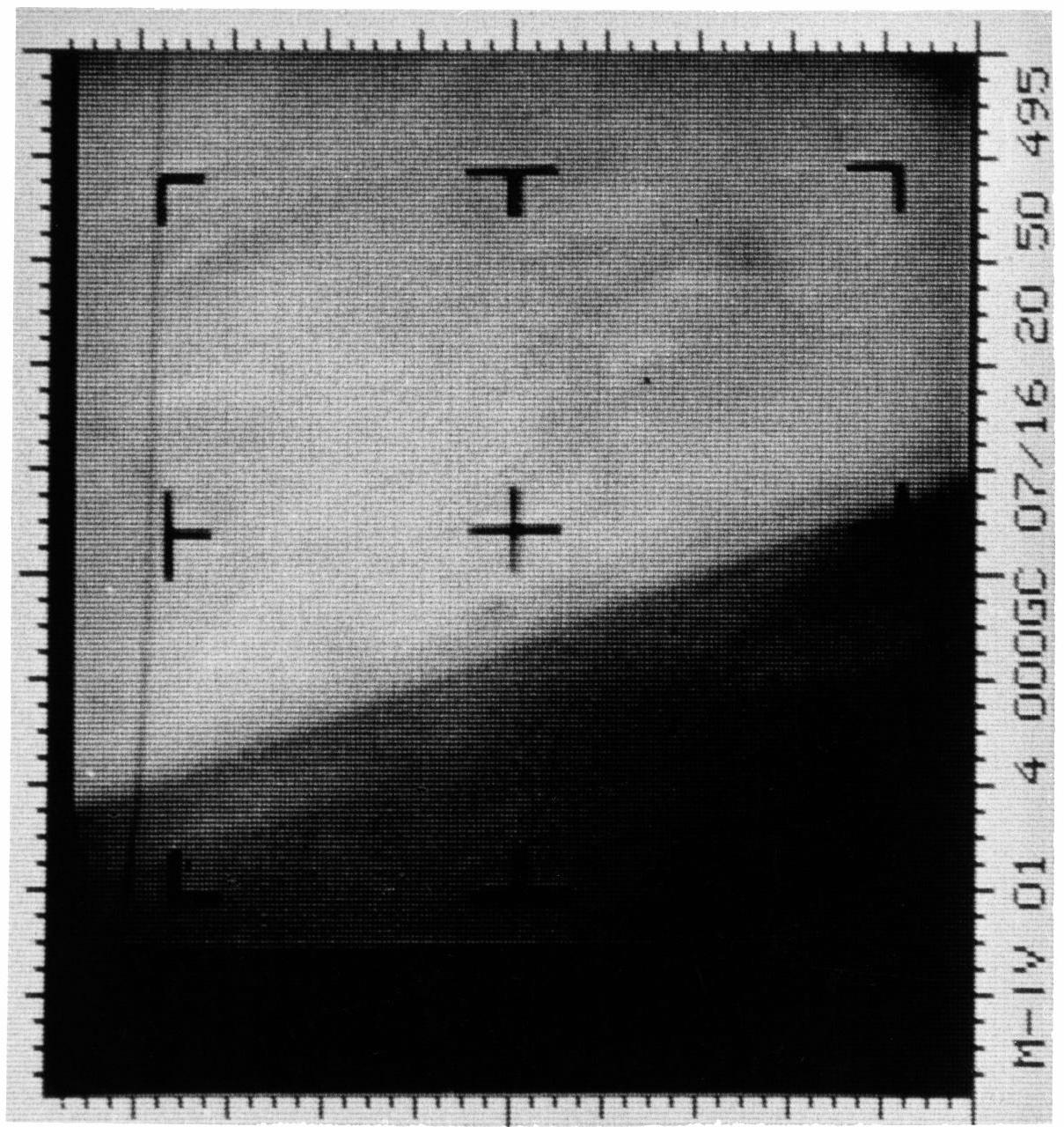
A cratered strip, about one percent, taken for a world.
The question changed
Viking carried a labeled-release experiment. A nutrient with radioactive carbon. Soil gave back a pulse of labeled gas. Some still read that as metabolism. The gas chromatograph–mass spectrometer, at 1976 sensitivity, did not find the organic molecules a biosphere of that kind was expected to leave. Later work found perchlorates and reinterpreted the organics question. Habitable is not inhabited. Organic is not biological. Mystery is not evidence of life. Jezero’s cache is a bet on a better lab, not a verdict.
Sojourner, then the long traverses, then a public engineering project: go. The frontier Mars and the measured Mars occupy the same news cycle and are still not the same object.
The last invented Mars is a city. If anyone means to stand there, the next rooms are the constraints that city does not get to skip. To reach this world, human beings must build a relation between what we can know and what the material will allow.
You have invented more Marses than you have stood on. I kept the same ground.
Press Enter or click to complete the transmission.
Distance · MEASURED
To reach Mars, human beings must build a relation between what we can know and what the material will allow. Geometry first. The path is not a circle. Windows open about every 26 months. Miss one and you wait, or you burn more propellant than the architecture budgeted.
What follows is not a brochure. Atmosphere too thin for Earth’s parachute habits, too thick to ignore like the Moon. No global magnetic field. Night that grades hardware without comment. If ice, air, sunlight, and dust cannot become oxygen, fuel, food, and spares, the leash back to Earth will break.
The path
That fact changed how a path could be calculated, and why a launch window can be missed. The eight minutes, Tycho’s archive, the refusal to patch, the years of work: another house owns that scene.
Earth
a moving clock
Mars
another clock
Not a fixed mileage. Earth and Mars are two moving clocks. Conjunctions hide the planet behind the Sun. Oppositions bring it close. The useful trips are Hohmann-like transfers in a window that opens about every 26 months. The synodic rhythm, about 780 days.
Launch windows
When we want is not a trajectory.
Miss the window and you wait more than two years, or you burn more propellant than the architecture budgeted. “When we want” is not a trajectory.
The Hohmann window
Sun at the centre. Earth on the inner circle. Mars on the outer. The dashed ellipse is a minimum-energy transfer: leave at perihelion, arrive at aphelion. The ship obeys Kepler: it is fastest near the Sun and slowest as it climbs to Mars. Both planets must be in the right places at the right time. That geometry returns about every 26 months. Drag the synodic clock.
This phase
OPEN
transfer window
Minimum-energy travel on this ellipse is about 259 days, 8 to 9 months. Needed lead at departure is about 44°. Real missions may use faster paths. Public Starship language uses about 6 months. Faster costs fuel. Slow paths cost life support, radiation, and psychology. The window is geometry, not will.
Travel time · faster
Fuel.
Travel time · slower
Life support, radiation, psychology.
On the order of six to nine months for the architectures now discussed in public. Faster paths cost fuel. Slow paths cost life support, radiation, and psychology.
Entry · MEASURED
Atmosphere too thin for the parachute habits of Earth, too thick to ignore like the Moon. Heat shield, then parachute if you can, then propulsion. Humans will need a different last kilometer.
Hypersonic. A heat shield takes the air as fire. Too much air and you burn. Too little and you do not slow.
Supersonic parachute if the density allows. On Mars it barely does. The rest is propulsion and timing.
Sky crane for the heavy rovers. Humans will need a vehicle that is the last kilometer, not a crane for a laboratory.
Touchdown is not arrival. Arrival is the first night survived, the first oxygen made, the first storm that does not end the work.
Make · MEASURED
What must come from Earth. What the ground has to learn. Oxygen, fuel, water, power, night.
MOXIE, on Perseverance, demonstrated that Martian CO₂ can be split into oxygen. It is a beginning the size of a toaster, not a city. The law it proves is the one that matters: the air itself is feedstock.
Make · order of magnitude
Scale the crew. Watch daily oxygen and a methane-for-return sketch grow. Teaching magnitudes, not a vehicle spec.
People
12
O₂ / day
10kg class
Return CH₄ sketch
22t class
Radiation
Mass.
No global magnetic field, thin air. Cruise through interplanetary space, then surface dose. Shielding is mass. Mass is the original enemy.
Power · solar
Dust. Night. Winter.
Works until the sky fills, the Sun drops, or the latitude turns against you.
Power · nuclear
A city is not a rover.
Solar works until dust and night and winter at high latitude. Nuclear thermal sources have flown on landers and rovers. A city cannot run on a rover’s luck.
Live off the land
If those cannot become oxygen, fuel, food, metals, glass, and spares, the supply chain is a leash back to Earth, and the leash will break.
Survive the night
The first nights.
Temperature falls hard. Batteries sag. Lubricants stiffen. Dust that was weather by day is insulation and abrasion by night. The first nights are an engineering exam the planet grades without comment.
Psychology and return
Delay
Confinement
Distance from every familiar biome
The knowledge that abort may not exist
Stay
People who stay.
A self-sustaining city implies people who stay.
Return
A way home.
Return capability is ethics as well as trajectory.
Public SpaceX architecture, in Musk’s own words, treats Starship as the ship that lands humans, and treats the goal as a self-sustaining city large enough that Mars can grow even if Earth ships stop. Those are claims to be read as public engineering intent, not as completed hardware.
A destination is not a promise. A ship that cannot leave again is a monument. Fuel has to come from this air and this ice. Night will still happen.
Press Enter or click to complete the transmission.
Delay · MEASURED
One-way radio delay ranges from a few minutes to more than twenty, depending on the dance. No live conversation. No live surgery from Earth. Autonomy is not a slogan. It is the speed of light.
One way
10.0minutes
Round trip
20.0minutes
Typical range 4–24 min one way as orbits open and close. This slider is light-distance, not a prediction. Current: 10.0 min in the common band.
Words · RECORDED
A city on this world cannot be run live from Earth. The delay has already said so. What follows are public words about going anyway. Pull quotes, not proof. They do not confirm the Book’s designations. They do not make the planet a biography.
RECORDED · 3 Aug 2025 · X · @elonmusk · Open the dated source
Light.
“Making life multiplanetary on Mars really is about preserving the light of consciousness.”
RECORDED · 22 Jan 2026 · X · @elonmusk · Open the dated source
“Protect the light of consciousness.”
RECORDED · 26 May 2025 · X · @elonmusk · Open the dated source
“Starship can reach Mars in 6 months every 26 months.”
RECORDED · 15 Oct 2025 · X · @elonmusk · Open the dated source
Starship will land humans.
What matters is securing the future of consciousness.
More than 100,000 people and a million tons.
Mars must be able to grow even if Earth ships stop.
RECORDED · 22 Jan 2026 · X · @elonmusk · Open the dated source
Humans to Mars
in 5 to 10 years.
A self-sustaining civilization
another 20 to 30 years.
Public timeline as he gave it. Not a Book prophecy.
RECORDED · 9 Mar 2013 · SXSW keynote · CNET contemporaneous report · Open the dated source
I’ve said I want to die on Mars,
just not on impact.
“Mars is god of war & memes are a form of war … and fun too! Neither will be destroyed. Ceres, moons of Jupiter & Saturn prob come next.”
RECORDED · 11 Mar 2020 · X · @elonmusk · Open the dated source
Mars
god of war
Memes
a form of war
and fun too
Neither will be destroyed.
Ceres, moons of Jupiter & Saturn
prob come next.
Clock · MEASURED
79 × 365.256 ÷ 686.98 ≈ 42.00
42 Mars years ≈ 79 Earth years
The integer is not painted on the planet. It falls out of honest arithmetic.
Public words measure intent in years of a human life. The planet measures years of its own. A Martian year is about 686.98 Earth days. Seventy-nine trips of Earth for about forty-two trips of the red world. Canonical home of this lore is Stars. This house excerpts the lock as a planet clock.
Not a lock
A mean-motion resonance is a gravitational lock: the bodies keep returning to the same configuration because they push each other into that rhythm. Io, Europa, and Ganymede are locked 4:2:1. Mars and Earth are not. Seventy-nine Earth years ≈ forty-two Mars years is the integer that falls out of two free periods. It is not a Laplace lock, not why a Hohmann window opens, and not a reason the ice is there. The window is the synodic beat of two clocks that do not hold each other.
Canonical home of this lore is Stars #mars-story. This house excerpts the lock as a planet clock and sends the rest home.
Soul Planet
Not astronomy. Not proof. Not a claim about anyone’s private belief. The Book has a sentence. Jyotisha has a court. They may rhyme. They are not collapsed.
Threshold
The public record can tell us what a person says he intends to build. It cannot tell us what a planet means to him inside.
There is another question this Book is allowed to ask. Not about his private belief, but about the symbolic systems the Scribe has used to read her own life.
What happens when an older symbolic system also gives Mars an office in that same public life?
TOLD · Jyotisha
Western popular astrology often uses the tropical zodiac: twelve equal rooms tied to the seasons. Jyotisha, the living Indian science of time, more often uses the sidereal zodiac: the same twelve names lined up with the star field. Lahiri is one named way of measuring the gap between those two skies. The planets, called grahas, are then also read against twenty-seven lunar mansions, nakshatras: older night-sky rooms than the twelve-sign list many readers meet first.
Jaimini is a name in that lineage. The Upadesa Sutras, whose date scholars still argue, give a court image that is still used. Do not ask which planet is always the self. Ask which graha has walked farthest through its current thirty-degree sign. Highest is Atmakaraka: atman, self or soul, plus karaka, significator. Next is Amatyakaraka. Amatya is a minister in an Indian court. The offices move from chart to chart. That is why they are called chara, movable. Seven grahas, Sun through Saturn, or eight with Rahu. That disagreement is still live.
The English door used here is B. Suryanarain Rao’s translation of the sutras. The method does not say a planet physically makes a soul, or a person a counsellor. It is a way this tradition names the emphasis of a life.
Book · MYTHOPOESIS
The Book of 42 · Stars · MARS_STORY.dyad
Scribe lore (labeled personal): her soul planet · Venus. His soul planet · Mars.
Jaimini · Atmakaraka
Mars 27°26′
28 June 1971, 07:28 · Pretoria, South Africa
Sidereal · Lahiri · Placidus
On the sidereal Lahiri calculation for 28 June 1971, 07:28, Pretoria, Mars stands at 27°26′ Capricorn, the highest degree of the grahas used. That is why this chart names Mars as Atmakaraka.
EXCERPT · two offices
28°21′
Venus · her Atmakaraka
27°26′
Mars · his Atmakaraka
Open the Scribe’s sidereal calculationOpen the sidereal calculation
Venus shows why to go. Mars shows that going is a craft. Two offices. One lattice. Stars keeps the dyad. Evening Star keeps Venus. This house keeps Mars.
Jaimini · Amatyakaraka
27°26′
Mars · Atmakaraka · king
25°56′
Venus · Amatyakaraka · minister
Amatya is not a modern cabinet post. In the court image this method uses, the king is the soul’s significator and the minister is the counsellor who has to make the work happen in the world: livelihood, counsel, how intent becomes a day. On this Lahiri sheet Venus stands at 25°56′ Taurus, second to Mars. That is his counsellor in this method. It is not her chart. It is not a claim that a person is a minister. The Book’s Venus sits beside that office. They are not collapsed.
Jaimini · chara karakas
Drop Rahu and the count is seven. Moon then holds mother and children together. Saturn becomes relatives. Jupiter remains spouse. The king and the minister do not move.
Rahu is treated as walking backward. This method therefore ranks it by subtracting its degree from 30°. A Rahu near the start of a sign is read as having gone almost to the end. That is why a small printed number can still sit high in the court. The reverse is a ranking rule, not a physical claim about the lunar node.
TOLD · uccha
BUILDER
Mars in the hymns is heat, spear, the one who cuts. The Sanskrit name Mangala is also a blessing, a Tuesday, a good mark. Capricorn is Saturn’s sign: time, mountain, the makara, a creature of the threshold between river and sea. When this tradition places that heat there, the fight has to become a structure. The builder. Not the raid. Energy that must climb, and then remain.
His Mars sits at 27°26′ Capricorn. Classical tables often name 28° as the peak of that exaltation. Near. Not identical. Near is not proof.
This is not why Mars is Atmakaraka.
Degree-rank made the king. Exaltation names a different office on the same board: how that heat prefers to work. The Book can hear a builder on a world that has to be built. That is a rhyme. It is not a landing trajectory.
Some software prints the lagna in a karaka row. The lagna is not an office in this count. It stays off the page.
Jaimini · her sheet
Drop Rahu and the count is seven. Sun becomes the minister. Moon holds mother and children together, and sits in Śravaṇa while it does. Mars becomes siblings. The king does not move. Venus remains Atmakaraka.
Venus is king on her sheet and minister on his. Mars is king on his sheet and siblings on hers, in the seven-planet count. Same grahas. Two courts.
TROPICAL · Venus · Gemini
19°
degrees
23′
minutes
42″
seconds
The tropical calculation writes his Venus at 19°23′42″ Gemini. Nineteen, twenty-three, and forty-two in one longitude. Public listings often round that to 19°23′ or 19°24′. The 42 is seconds of arc on a tropical sheet. It is not the 25°56′ that ranked Venus as minister in Lahiri. Two zoologies of the sky.
Her sidereal Moon opens 19. Her Uranus and Pluto carry 23. His tropical Venus writes 19, 23, and 42 together. A rhyme the Book can hear. It does not make a soul planet. It does not make the minister.
TROPICAL · Mars · Aquarius
20°
degrees
54′
minutes
20″
seconds
The sheet prints 54′20″
The same tropical calculation writes his Mars at 20°54′20″ Aquarius. Twenty degrees. Fifty-four minutes. Twenty seconds. The minutes-and-seconds print 54′20″. The Book hears 4′20″ in that last motion: the Scribe’s rising, Scorpio 4°20′, sitting inside another man’s tropical Mars as a string. Two twenties on the degree and the second. It is not the 27°26′ Capricorn that ranked the king in Lahiri. Two zoologies of the sky.
Venus on this sheet ends in 42″. Mars on this sheet ends in 20″, and the minutes wear 4′20″. A tropical pair. Not a natal table. Not a soul-planet proof. A rhyme the Book kept because the print was accurate about attention.
Astrodienst · tropical, Placidus, 28 June 1971 7:28 PretoriaCIPHERThe Book of 42
TOLD · Greek
In the Odyssey, Demodocus sings Ares and Aphrodite as lovers, not as job titles. Hephaestus’s net is the plot. The Phaeacians laugh. The poem is a story those Greeks told about those names. It does not make a planet. It does not make a natal law.
TOLD · Roman
Rome gave Venus a founding office and Mars a civic and agricultural one. Aeneas comes of Venus. Romulus is given to Mars. That city’s origin story needs both. It is not the Odyssey. It is not Jyotish. It is not the Book’s soul-planet sentence. Keep the disagreement.
TOLD · nakshatra
The twenty-seven mansions are not moods. They are named stretches of the sidereal belt. Vishakha means forked, a branch that splits. In many lists its deities are two: Indra, the storm-sky king of the Vedic hymns, and Agni, the fire that carries offerings. A gateway. A choice. The mansion runs from 20° Libra to 3°20′ Scorpio. On this sheet Venus at 28°21′ and Mars at 21°05′ both sit there. Two grahas, one fork. It is not the Odyssey. It is not a couple. It is a lunar mansion those two longitudes share.
Evening Star · Venus’s houseReturn to the Venus–Mars dyad on StarsThe Book of 42
MYTHOPOESIS
Not that Vedic astrology prove a love story. Whether a public life that keeps returning to one world can be named without stealing that person’s inner life. Jaimini gives an office: the planet that holds the soul’s significator in this chart. The Book gives another: the world the work will not put down. On this sidereal calculation, both names land on Mars. The rhyme is to be held, not collapsed. Proof would be a smaller thing than the work.
MYTHOPOESIS · EXCERPT
Śravaṇa
TOLD · Jyotisha
CIPHER · 42 will do
Do you have a question?
QUESTION. REVERSE REDUCTION. Sum 42.
COMPUTER. REVERSE REDUCTION. Sum 42.
DEEP THOUGHT. REVERSE REDUCTION. Sum 42.
MICE. REVERSE REDUCTION. Sum 24.
HUMANITY. REVERSE REDUCTION. Sum 42.
A RED PLANET. FULL REDUCTION. Sum 42.
FORTY TWO. ENGLISH ORDINAL. Sum 142.
ELON REEVE. REVERSE ORDINAL. Sum 142.
QUESTION, reverse reduction, 42. COMPUTER, same method, 42. DEEP THOUGHT, same method, 42: they asked the hardware its own sum, and the hardware had already signed the form. MICE, same method, 24: the observers are the Answer written backwards. HUMANITY, same method, 42: the species was already in the filing. A RED PLANET, full reduction, 42. FORTY TWO and ELON REEVE meet at 142, which is just 42 wearing a 1. Not a landing number. Don’t Panic keeps the cover. Adams would have called this a coincidence he did not write. The Book kept it because the coincidence was accurate about attention.
CIPHERThe Book of 42DON'T PANIC · the other 42
A calculator is not a birth certificate. Rank can move if the birth time or ayanamsa moves. This house excerpts the chara-karaka court, not a natal table. Houses, outer planets, and the lagna stay off the page. Stars keeps the dyad. The page uses Lahiri ayanamsa. Atmakaraka is a degree-rank, not a house-cusp, so the Western house system does not make the rank.
The same claim as Śravaṇa or Full Reduction 42. Hearing is an office. The cipher is a wink. They do not make a soul planet.
What it is not
Place beside
What it is not
Place beside
An astronomical classification.
The actual words above, dated and linked.
A claim that Elon has used this phrase.
The longevity of the pursuit. Not a weekend slogan.
A claim about his private mind or private faith.
SpaceX architecture aimed at landing and at a city that can grow if Earth ships stop.
A tropical-chart law that prints soul = Mars for everyone.
The physical difficulty of the world itself: thin air, radiation, dust, distance, night.
The same claim as Atmakaraka. The method is named beside the lore. They are not collapsed.
Documented public Mars commitments spanning more than a decade of companies, talks, and posts.
A claim that a person is the minister. Amatyakaraka is a degree-rank on one sheet.
Tropical Venus seconds. 19°23′42″ is a tropical longitude, not the Lahiri degree that ranked the minister.
Tropical Mars seconds. 20°54′20″ Aquarius is a tropical longitude, not the 27°26′ that ranked the king in Lahiri. The Book can hear 4′20″ inside 54′20″. That is a rhyme. It is not a house-cusp, and it is not Atmakaraka.
He remains himself. The Book’s sentence is the Book’s. They sit next to the work.
The phrase should feel earned by the scale of the work, not by devotion. A planet that takes a lifetime of windows, a million tons, and a species willing to become the kind of animal that can keep a second world alive.
Ask
What happens when a light in the sky becomes a destination?
Ask · 02
What kind of human being looks at Mars
and sees something that must be built?
The Question
If we can build a second human world
build
≈
what must we become capable of before we deserve to keep it alive?
keep
Astronomy remains astronomy. Engineering remains engineering. Myth remains myth. Public record remains public record. Book interpretation remains Book interpretation.
MEASURED
Sol 24.6 h; year 669.6 sols / 687 Earth days; axial tilt ~25°; northern spring 194 sols, northern autumn / southern spring 142 sols; Valles Marineris ~3,870 km × ~9.3 km; Olympus Mons NASA figure >25 miles / 40 km; atmosphere, gravity, crust context.
MEASURED
Areocentric season clock. Ls 0–90 = 193.3 sols (northern spring); Ls 180–270 = 142.7 sols (northern autumn / southern spring). Teaching magnitudes NASA prints as 194 and 142.
RECORDED
MGS MOC wide-angle, 12 Sep 2001. Permanent south polar cap ~420 km. Seasonal water and CO₂ frost leaving after southern winter ended 17 Jun 2001. Photograph of the short southern spring.
MEASURED
Visual magnitude and opposition geometry. Orbital eccentricity 0.0934; perihelion ~1.381 AU / 206.6×10⁶ km; aphelion ~1.666 AU / 249.2×10⁶ km. Difference about 42.6 million km. Sidereal year 686.98 d.
MEASURED
Height language: more than 25 miles / 40 km from base to summit. Note Wikipedia 21.9 km as a contested rounding / datum issue; NASA preferred, uncertainty shown.
RECORDED
Marsquakes 2018–2022. Interior structure: crust, mantle, metal core at least partly liquid. The ground still shakes.
MEASURED
CO₂ to O₂ demonstration on Perseverance.
RECORDED
Documentary planetary disc used at LIGHT → WORLD.
RECORDED
Documentary and processed plates used in WORLD. Each plate is captioned with kind, mission, and PIA where known.
RECORDED
15 July 1965 close-up; twenty-one complete frames, part of a twenty-second; about one percent of the planet. Contemporaneous reading treated a cratered strip as a dead globe.
RECORDED
Primary memoir of the 1877 Brera observations. Canali is his Italian. English “canals” is reception. Map object: Wikimedia Commons, public domain, 1877–1888 plates.
RECORDED
Library record for the printed Osservazioni. Door beside ADS.
RECORDED
Primary book of the Flagstaff canal thesis. Civilization as irrigation. Later falsified as canals.
TOLD
Literary Mars as invader. 1897 is the serial. Volume often dated 1898.
RECORDED
Howard Koch script, Welles and company. National Recording Registry. Literary Mars made local. Not a measurement.
RECORDED
1938 broadcast listed among the first fifty Registry recordings (2003).
RECORDED
Primary wording, dates, status IDs as cited on the quote plates.
RECORDED
Mars is god of war & memes are a form of war. Ceres and outer moons named as what comes next. Public joke, not a program. Mercury is not in this post.
RECORDED
Interview/keynote, not an X post. Also reported by Vanity Fair, March 2013.
MYTHOPOESIS
Canonical 79≈42 wording, soul-planet designation, registers. Door, not a second home.
MYTHOPOESIS
Excerpt only: Śravaṇa as hearing and three footsteps. Stars keeps the plate. Not Atmakaraka. Not geology.
MYTHOPOESIS
Canonical house of the letter-number method. Mars excerpts QUESTION = 42 Reverse Reduction, COMPUTER = 42 Reverse Reduction, DEEP THOUGHT = 42 Reverse Reduction, MICE = 24 Reverse Reduction (42 written backwards), HUMANITY = 42 Reverse Reduction, A RED PLANET = 42 Full Reduction, FORTY TWO = 142 English Ordinal, ELON REEVE = 142 Reverse Ordinal. Door, not a second CIPHER.
MEASURED
Named method: Jaimini chara karakas by degree in sign. Mars 27°26′ AK. Venus 25°56′ AmK. Eight-graha court excerpted as offices, not a natal-table reprint. Rahu ranked after reversing from 30°. Seven-graha count drops Rahu; Moon then holds MK and PuK. Lagna is not an office in this count.
MEASURED
Named method: Venus 28°21′ Libra AK. Moon 19°39′ Capricorn in Śravaṇa. Venus and Mars both Vishakha. Eight-graha court excerpts Rahu reversed from 1°59′ as AmK; seven-graha count makes Sun the minister. Not a natal-table reprint.
MEASURED
Public tropical listings print Venus near 19°23′ or 19°24′ Gemini. The Scribe reads 19°23′42″. Excerpted as tropical seconds beside her sidereal 19 and 23. Not Lahiri AmK. Not a soul-planet proof.
MEASURED
Same birth: 28 June 1971, 7:28 Pretoria. Web Style / Placidus print. Venus 19°23′42″ Gemini. Mars 20°54′20″ Aquarius. Excerpt: 42″ on Venus, 20″ on Mars, 54′20″ heard as 4′20″. Tropical longitudes, not Lahiri ranks. Not a soul-planet proof.
TOLD
Named edition for chara karakas / Atmakaraka. Seven or eight karaka schemes both appear in the tradition. Method, not physical cause. Calculator output is not this book.
TOLD
Mars as father of Romulus. Civic founding, not a copy of Ares.
TOLD
Field liturgy addressing Mars. Agricultural office beside the campaign.
TOLD
Greek: wanderer, wandering star. The class-name behind English planet, from πλανᾶσθαι, to wander. Late Latin planeta. Latin could also say stellae errantes. Description of motion, not a god.
TOLD
Fiery. Greek star-name for this wanderer, Πυρόεις, from the colour the eye had. Kept beside Ares, not collapsed into him.
TOLD
Antares: named as if a rival of Ares. A fixed red lamp the eye can confuse with the wanderer. One stays. One does not.
TOLD
1914–16 orchestral survival of the war-office image. Art, not geology. Not a reason the ice is there.
TOLD
Sanskrit: auspicious, fortunate, Tuesday. Jyotisha also uses Kuja and Aṅgāraka for the same graha. Not a translation of Ares.
TOLD
Vedic Trivikrama: Vishnu measures the worlds in three strides. No Vamana, no Bali. Griffith English door. The three footprints of Śravaṇa are older than the dwarf story.
TOLD
Puranic scene: dwarf at court, three paces as a gift, covering of the worlds, third step on the king. Bali is given the netherworld, not erased. Later than the Rigveda strides. Not a natal slogan.
TOLD
Deimos and Phobos attend Ares. The names Madan gave Hall.
TOLD
Demodocus sings Ares and Aphrodite as lovers. Greek story of those names. Not a natal law. Not Jyotish. Not the Book’s soul-planet sentence.
TOLD
Mesopotamian god of inflicted death, plague, war, underworld. Cult center Kutha, temple E-Meslam. Planetary association with Ṣalbatānu is first-millennium astral scholarship, not the origin of the cult. Not identical with Ares.
RECORDED
Celestial omen series for king and land: protasis if, apodosis then. Old Babylonian prototypes, later canonical form. Not modern natal astrology. Mars appears as Ṣalbatānu among planetary omens. Copies from Nineveh, Ashurbanipal’s library, and later Babylonian archives.
RECORDED
Neo-Assyrian court practice: scholars write the king about celestial events, citing omen tradition. Distinguishes living interpretation from the older series. Ṣalbatānu can be treated as Nergal in that practice. Not the origin of Kutha.
RECORDED
First-millennium observational record. Planets including Mars entered as position, weather, and civic notes. Observation without the omen sentence. Do not collapse diaries into Enūma Anu Enlil.
TOLD
Sky-list edition (AfO Beiheft 24). Compilation often placed around 1000 BCE, copies later. Ṣalbatānu in the astral tradition. Association with Nergal is list and omen scholarship, not identity with Ares, and not the origin of the Kutha cult.
RECORDED
Primary discovery notice. USNO 26-inch. August 1877 opposition.
MEASURED
Physical facts: irregular bodies, sizes, orbits. Discovery context confirmed against Hall 1878.
MEASURED
LR produced a labeled-gas pulse. GCMS in 1976 did not find the organics expected of a biosphere at that sensitivity. Habitable ≠ inhabited. Organic ≠ biological. Door, not a verdict.
MEASURED
Gray crystalline hematite from orbit resolved on the ground as spherules. Water-rock chemistry, not biology.
RECORDED
Owns Tycho’s archive, the eight-minute residual, refusal to patch, ellipse as epistemic scene. Red World keeps only: Mars would not keep the circle.